Bismillah.
• The secular nationalist Young Turks movement, of which Atatürk was the most famous member, can trace its line
age back to individuals of Jewish descent who pretended to be Muslim in public. In fact, many members & supporters of the Young Turks were ardent Jewish Zionists.
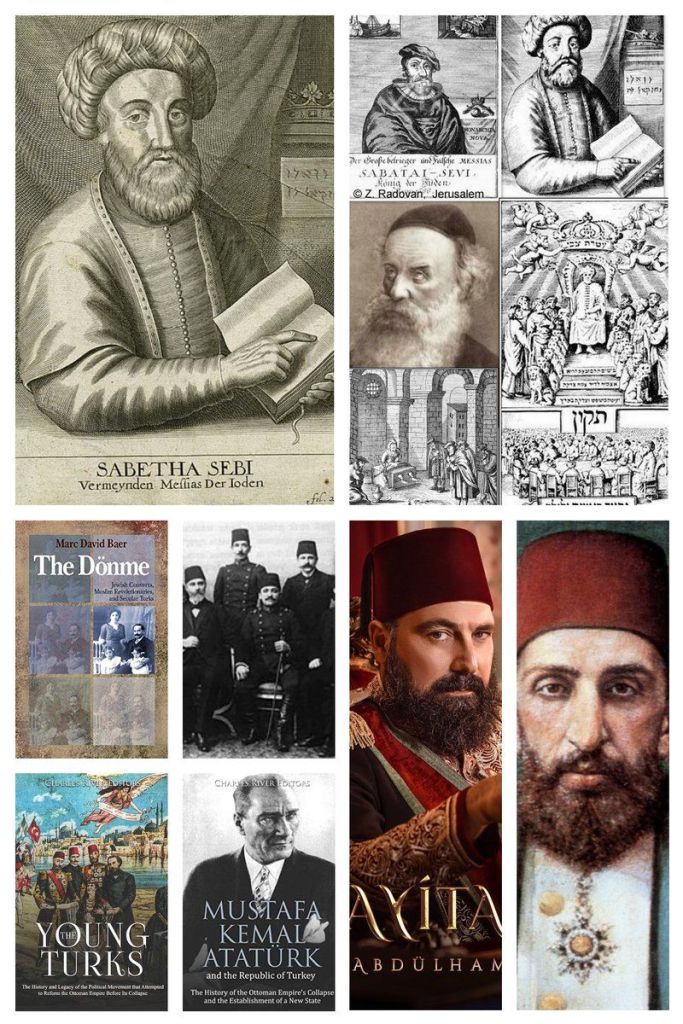
• Rabbi Sabbatai Zevi (Shabbethai) a 17th-century Jewish mystic from Smyrna (İzmir, Turkey), gained fame as a kabbalist, attracting numerous Jewish devotees, and eventually claimed to be the Messiah.
• Rabbi Sabbatai Zevi, born in Smyrna in 1626 on the Jewish day of mourning, Tisha B’Av, came from a Romaniote Jewish family. His father, Mordecai, was a poultry dealer in the Morea, who later became a successful Smyrna agent for an English trading house during the war between the Ottomans and Venetians. The name Sabbatai, meaning Saturn in Hebrew, was associated with the Messiah in Jewish tradition.
• As a boy Sabbatai studied the Talmud in line with Jewish customs, attending a yeshiva in Smyrna. While uninterested in Jewish law, he excelled in the Talmud and was drawn to mysticism and the Kabbalah, influenced by Isaac Luria.
• His fascination extended to practical Kabbalah, involving ascetic practices to connect with God & “angels” (most likely demons/jinn), predicting the future, and performing “miracles”. He engaged with Luria’s writings, the Zohar, and undertook ascetic and purification exercises known as tikkunim.
• In the 17th century, millenarian ideas predicting messianic times, including the redemption of Jews and their return to Israel with sovereignty, gained popularity, notably in England where 1666 was considered an apocalyptic year, influencing Menasseh Ben Israel’s appeal to readmit Jews based on this belief.
• Sabbatai’s father, an agent for an English trading house in Smyrna, likely had business connections with English people. There is ongoing scholarly evaluation regarding the extent of influence of English and Dutch Calvinist millenarianism on the messianic movement associated with Sabbatai Zevi.
• In 1648, Sabbatai declared himself the messianic redeemer in Smyrna, backing his claim with symbolic acts like pronouncing the Tetragrammaton and asserting supernatural abilities such as flying (he told his followers that he couldn’t do so in public because they were ‘not worthy enough’ to witness such a sight) and having visions of God.
• At the age of twenty-two, Sabbatai’s influence was limited in the rabbinic community of Smyrna, facing suspicion from established leaders led by Joseph Escapa, resulting in eventual excommunication due to his bold messianic claims.
• In 1651, Sabbatai and followers were expelled from Smyrna; later, in 1658, he reappeared in Constantinople, where preacher Abraham Yachini affirmed Sabbatai’s messianic role with a forged manuscript:
“I, Abraham, was confined in a cave for forty years, and I wondered greatly that the time of miracles did not arrive. Then was heard a voice proclaiming, “A son will be born in the Hebrew year 5386 [the year 1626 CE] to Mordecai Zevi, and he will be called Shabbethai. He will humble the great dragon; he, the true Messiah, will sit upon My throne.”
• Sabbatai proclaimed himself the Messiah in Salonica, gaining more followers through mystical events, but was banished by local rabbis again, leading him to settle in Cairo for about two years.
• There he befriended Raphael Joseph Halabi (of Aleppo), a wealthy and influential Jew who held the high position of mint master and tax-farmer in Cairo under the Ottoman government.
• Raphael Joseph led an ascetic life, which included fasting, bathing in cold water, and whipping himself at night, and used his great wealth for charity, supporting poor Talmudists and Kabbalists, fifty of whom reportedly dined at his table regularly. He became a supporter and promoter of Sabbati’s messianic claims.
• In 1663, Sabbatai engaged in ascetic practices in Jerusalem, gaining recognition for his piety, singing psalms, and attracting followers through mystical interpretations of Spanish love songs.
• During Sabbatai’s second stay in Cairo, his fame grew after he claimed a young Jewish orphan named Sarah, previously a prostitute, was promised to him as a consort in a dream. They married, and her unconventional life added followers, paralleling the biblical story of Hosea.
• Sabbatai, backed by Halabi’s financial support, returned triumphantly to Jerusalem, gaining followers and encountering Nathan of Gaza, who proclaimed himself the risen Elijah. In 1665, Nathan predicted the Messianic Age starting in 1666 without bloodshed.
• Facing opposition in Jerusalem, Sabbatai moved to Smyrna again, where he declared himself the Messiah in 1665. His followers hailed him as “AMIRAH,” meaning “Our Lord and King, his Majesty be exalted.”
• Sabbatai, with his wife’s assistance, became a community leader, suppressing opposition by deposing the existing rabbi and appointing a replacement in Smyrna.
• His messianic movement gained fame in Italy, Germany, and the Netherlands, with rumors reaching influential figures like Henry Oldenburg, sparking discussions of a potential return of Israelites to their homeland.
• Sabbatai’s followers, including notable rabbis like Isaac Aboab da Fonseca and Moses Raphael de Aguilar, grew in number.
• Reports of fantastical events circulated widely. In 1666, the Jewish community in Avignon, France, prepared to emigrate to the anticipated new kingdom.
• Amidst the 17th-century turmoil and pogroms in Eastern Europe, Sabbatai Zevi’s messianic claims found acceptance among Jews seeking salvation from their dire circumstances.
• Sabbatai’s followers intended to eliminate certain rituals, believing that in the messianic era, there would be no need for such obligations. This included transforming the fast of the Tenth of Tevet into a day of celebration instead of solemn observance.
• Sabbatai’s celebration of his birthday over a holy day sparked outrage among Jews, causing dissent and putting opposing leaders, like Solomon Algazi, at risk of violence from Sabbatai’s followers.
• In 1666, Sabbatai left Smyrna for Constantinople and was arrested by the Grand Vizier of the Ottoman Caliphate. Word had reached him that “prophecies” were circulating, suggesting that Sabbatai would crown himself as the new Sultan, this was seen as posing a direct political threat.
• Despite imprisonment, Sabbatai and his followers remained undeterred, and rumors of his supposed miraculous deeds spread, fueling messianic expectations in the Jewish diasporas.
• Imprisoned in Constantinople for two months, Sabbatai moved to Abydos, renaming it Migdal Oz. Despite violating Jewish Law, he lived lavishly with support from followers.
• Exaggerated accounts spread about him, leading to prayers in synagogues around the world and disruptions. Sabbatai introduced new feast days and even considered celebrating the Day of Atonement. The fervor extended to Moravia , Sale & Morocco.
• A Jewish enemy of Sabbatai called Nehemiah informed the authorities in Constantinople about Sabbatai’s ongoing ambitions, Sabbatai was taken to Adrianople.
• There, the vizier presented him with three choices: facing a trial of divinity by a volley of arrows, being impaled, or converting to Islam. Sabbatai chose conversion.
• On September 16, 1666, Sabbatai appeared before Sultan Mehmed IV, shedding his Jewish attire and donning a Turkish turban to signify his conversion.
• In recognition, the Sultan granted him the title Mahmed Effendi and appointed for him a generous stipend. Sabbatai’s wife, Sarah, and around 300 families among his followers also embraced Islam, forming a group known as Dönme.
• This marked a significant turning point in Sabbatai’s life, as he transitioned from being a Jewish messianic figure to a prominent figure within the Ottoman Empire.
• Sabbatai’s conversion left his followers devastated, facing ridicule from both Muslims and Christians. Despite his apparent apostasy from Judaism, some adherents clung to the belief that it was part of a messianic plan.
• Influential figures like Nathan of Gaza supported this view. Sabbatai alternated between portraying himself as a devout Muslim in public, denouncing Judaism, and practicing kabbalistic Judaism in private.
• A mystical work, possibly by Sabbatai or his followers, asserted him as the true Messiah, aiming to convert Muslims to Judaism, while he simultaneously told the Sultan he was converting Jews to Islam, allowing him to preach in synagogues.
• Gradually the Ottomans tired of Sabbatai’s many antics, ended his generous stipend. At the beginning of 1673, the Sultan had Zevi exiled to Ulcinj where his wife died in 1674. Zevi then married Esther, the daughter of rabbi Joseph Filosoff of Thessaloniki.
• In 1676, Sabbatai sent a letter to the Jewish Community in Berat, Albania, seeking religious books. Shortly afterward, he died in isolation, possibly on September 17, 1676. His widow, brother, and children moved back to Thessaloniki.
• Initially thought to be buried in Berat, recent research suggests his burial in Dulcigno. His tomb was a pilgrimage site for Dönme until the early 20th century.
• By the 1680s, the Dönme community had gathered in Salonica, leading a communal life with intermarriage, shared business, and secret traditions.
• The Dönme Sabbatai left behind continued to be crypto-Jews in the Ottoman Empire. Publicly pretending to be Muslims but secretly maintaining their Jewish faith and Kabbalistic beliefs.
• The Turkish word “dönme” originates from the root “dön-” meaning “to turn” or “to convert,” with a negative connotation of being a “turncoat.”
• Historian Rıfat Bali (scholar specializing in the history of Turkish Jews) defines it as a gerund, encompassing betrayal, conversion, and specifically referring to the followers of the false Messiah, Sabbatai Sevi, thus carrying a negative reputation.
• Muslims always viewed the Dönme to be Zanādiqa / Zindīqs, meaning they perceive them to be faux Muslims intending and plotting to destroy Islam.
• The Young Turk movement, which played a crucial role in the overthrow of the Ottoman Caliphate, included members of Jewish Dönme descent.
• The maneuvers of the Dönme were said to be at the core of the Young Turk Revolution, leading to the overthrow of Sultan Abdul Hamid II, the dissolution of the Ottoman religious establishment, and the establishment of a secular republic.
• Sultan Abdul Hamid II was a great bulwark against the Zionist project. The Ottomans had declared bankruptcy in 1875 and a large portion of the budget was allocated to paying interest on the huge foreign debt the empire had accrued during its decline.
• Nevertheless, in one particularly impressive act of Islamic loyalty, Sultan Abdul Hamid II famously turned down Theodor Herzl and the Zionist movement, which offered to buy Palestine in exchange for paying down some of the empire’s looming foreign debts.
• Sultan Abdul Hamid II is reported to have said:
“If Mr. Herzl is as much your friend as you are mine, then advise him not to take another step in this matter. I cannot sell even a foot of land, for it does not belong to me, but to my people. My people have won this empire by fighting for it with their blood and have fertilized it with their blood. We will again cover it with our blood before we allow it to be wrested away from us. The men of two of my regiments from Syria and Palestine let themselves be killed (shahid) one by one at Plevna. Not one of them yielded they all gave their lives on the battlefield. The Ottoman Empire belongs not to me, but to the Ottoman people. I cannot give away any part of it , let the Jews save their billions. When my Empire is partitioned, they may get Palestine for nothing. But only our corpse will be divided. I will not agree to a vivisection.”
• With the help of some Ottoman Christians & influenced by European secular liberalism, the Young Turks eventually successfully terminated Sultan Abdul Hamid’s 30-year reign and its Islamic-oriented administration.
• Although they didn’t immediately abolish the sultanate, in the subsequent thirteen years, two more sultans would rule, albeit as mere puppets without authority. The Young Turks held genuine power for the remaining period of Ottoman history.
• Louis Lipsky (1876 – 1963 ) President of the Zionist Organization of America once said about Sultan Abdul Hamid II:
“With the passing of Abdul Hamid, the greatest stumbling block in our plans has been removed. Zionists may now face the future with a smile, as they have never had a better opportunity for carrying out their wishes. The movement was started, in a political sense, about twelve years ago by Dr. Theodore Herzl, a Viennese Journalist. Dr. Herzl tried to enter
into negotiations, before his death, with Sultan Abdul Hamid to open the doors of Palestine to the Jews, and to grant autonomy to the territory. He was unsuccessful in his efforts.”
(Credit to @IsmailogluF for this quote.)
• The Zionists eventually realized their desire to establish a national state for Jews. The Rothschild banking family played a crucial role in the formation of Israel.
• The Balfour Declaration, issued by the British government on November 2, 1917, expressed support for a “national home for the Jewish people” in Palestine and was addressed to Baron Lionel Walter Rothschild, a prominent British Jewish leader and member of the Rothschild banking family.
• Lord Arthur Balfour was a Christian. He belonged to the Church of Scotland, and his Christian messianic beliefs influenced his political views, including his support for the Zionist movement and the issuance of the Balfour Declaration.
• Here are some notable members & supporters of the nationalist secular Young Turks movement who were also supporters of Zionism:
– Vladmir Ze’ev Jabotinsky
– Munis Tekinalp
– Emmanuel Carasso
– Mehmet Cavit Bey
– Baron Max Von Oppenheim
– Talaat Pasha
– Jacobus Kann
– Alexander Parvus
• Some historians assert that Mustafa Kemal Atatürk was a Dönme, while others disagree. What is undisputed, however, is his involvement in the Young Turks movement and his aversion to Islam.
• While he strategically employed religious rhetoric at specific junctures to garner trust from the religious populace, once he attained ultimate power, the secular reforms he implemented unmistakably conveyed a profound disdain for Islam and a desire to take the Turkish people as far away from Islam as possible:
– Abolition of the Caliphate
– Abolished the Grand Mufti
– Introduction of the Swiss Civil Code
– Banned Islamic Jurisprudence
– Closure of religious courts
– Adoption of the Turkish alphabet
– Qur’an & Azan in Turkish not Arabic
– Secularization of education
– Banning Madrassas
– Dress code reforms
– No religious attire allowed
– Men by law had to wear western style hats
– No Hijabs in public spaces
 Moro Blanco
Leave a comment