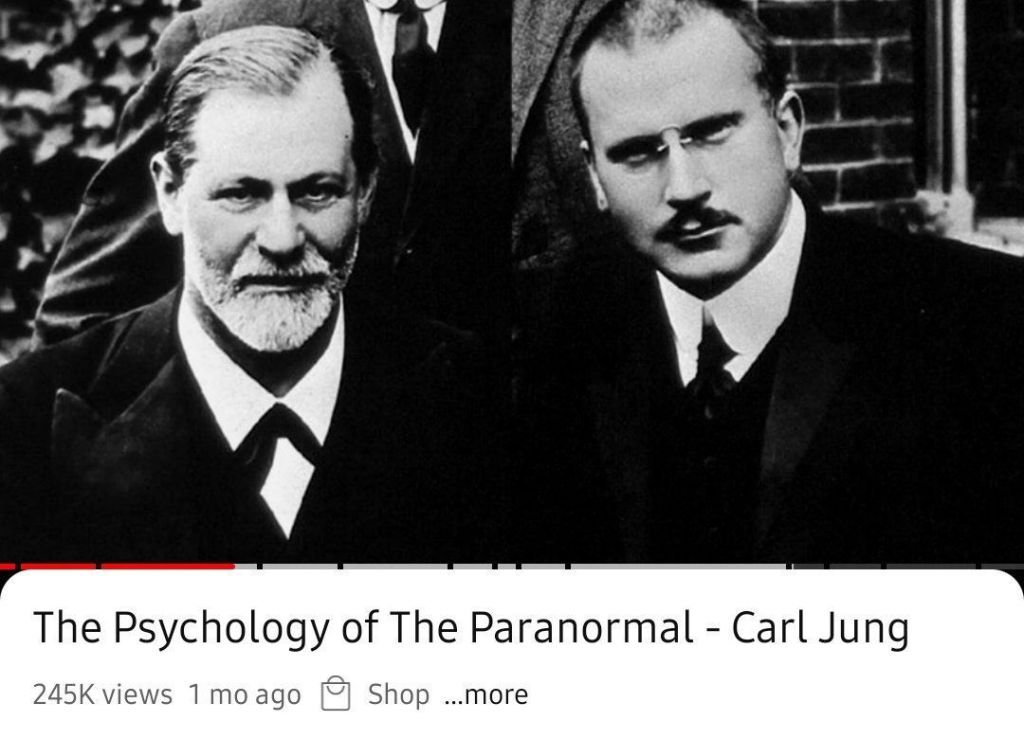
– Jung had many paranormal experiences from a young age, including encounters with ghosts, visions, and premonitions, which shaped his worldview and interest in the occult.
– Jung’s family had a history of psychic abilities, with his maternal grandfather, grandmother, and mother all experiencing supernatural phenomena.
– Jung’s early experiments with mediums and séances led him to witness phenomena like materialization, levitation, and collective visions, which challenged his scientific understanding.
– Jung’s disagreements with Freud over the validity of paranormal phenomena contributed to their split, as Freud wanted to make the sexual theory a dogma.
– Jung’s confrontation with the unconscious during his “confrontation with the unconscious” period resulted in visionary experiences and communication with inner figures like Philemon.
– Jung’s theory of synchronicity proposes a meaningful connection between psyche and matter, beyond the limitations of causality and space-time.
– Jung had premonitions and psychic experiences related to deaths in his family and other significant events, which he saw as manifestations of the collective unconscious.
– Jung had mystical experiences in places like Ravenna, Italy, where he witnessed visions and phenomena that could not be later verified, suggesting a reality beyond the physical.
– Jung believed that the dead continue to evolve and develop, and that the living can aid the postmortem development of the deceased through increasing consciousness.
– Jung remained open-minded about the existence of spirits and ghosts, eventually admitting that paranormal phenomena could be better explained by the hypothesis of spirits than solely by the unconscious.
“Carl Gustav Jung (1875-1961) was a Swiss psychiatrist and psychoanalyst who founded analytical psychology. Jung is best known for his theories on the collective unconscious, archetypes, and psychological types. He introduced concepts such as introversion and extraversion and explored the significance of dreams and the role of symbols in human psychology. Jung’s work has had a profound influence on psychology, psychotherapy, literature, and religious studies. He collaborated with Sigmund Freud early in his career but later developed his own theories, leading to a split between the two thinkers.”
 Moro Blanco
Leave a comment