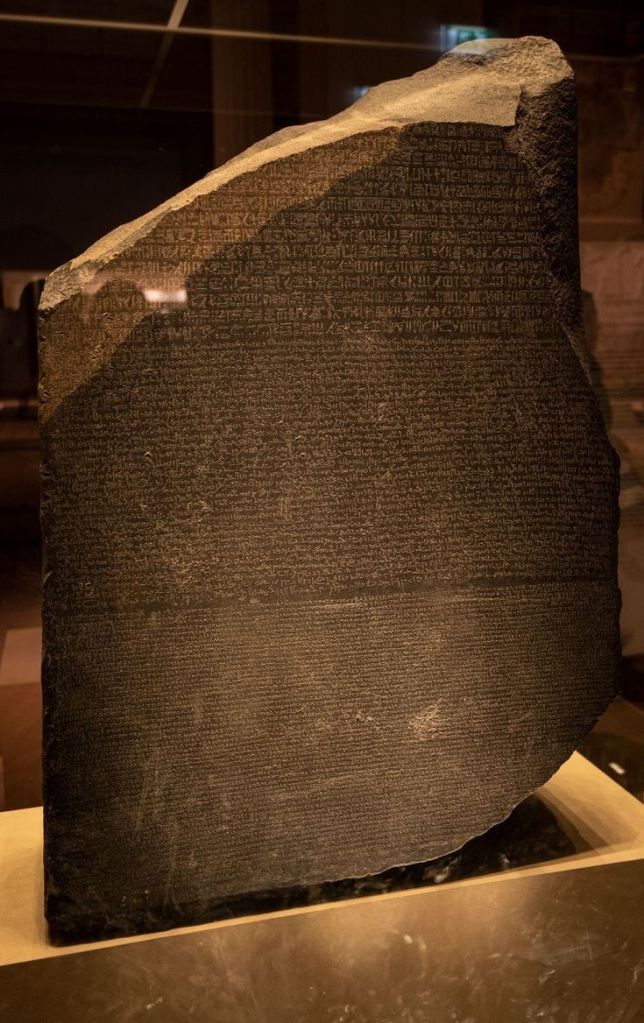
One of the most important archaeological discoveries of all time was a tax document.
The Rosetta Stone is regarded as one of the most important archaeological discoveries of all time. It was found in 1799 by one of Napoleon’s officers in the northern Egyptian town of Rosetta – today Rashid – as French soldiers plundered ancient Egyptian tombs for relics to send home to France.
Today, much to the consternation of the Egyptian authorities, the stone sits in the British Museum, perhaps its most prized asset. This celebrated slab of black granite has been dated to 196 BC, to the Hellenistic period, when Egypt was ruled by the Ptolemaic Greeks.
Its importance lies in the fact that it was inscribed in three different ancient scripts – ancient Greek (the language of the rulers), demotic (the language of the people) and hieroglyphs (the language of the temples).
The three scripts together meant that scholars were finally able to decipher these ancient languages, especially the hieroglyphs, which had hitherto baffled them and so 4,000 years of ancient culture were unlocked.
We know that something important was being said because of the decision to inscribe the words in stone, rather than use papyrus. Set in stone, it would last. We also know it was important because of the trouble taken to inscribe it in three different languages.
This way, as many people as possible would understand it. What exactly was being said that was so important? The stone is a fragment of a larger stone inscribed with a decree made by the child king Ptolemy V after an uprising.
It seems to have been an attempt to make peace following a victory against Egyptian secessionists to restore ‘the civilized life of men’. The form of the peace seems to have been amnesty for the secessionists, in particular tax amnesty.
According to the decree, Ptolemy V has ‘dedicated to the temples revenues in money and corn and has undertaken much outlay to bring Egypt into prosperity’. ‘Of the revenues and taxes levied in Egypt some he has wholly remitted and others he has lightened, in order that the people and all the others might be in prosperity during his reign.’
He forgives the debts ‘which they in Egypt and in the rest of the kingdom owed’. He decrees that ‘gods shall continue to enjoy the revenues of the temples’ and that priests ‘should pay no more as the tax for admission to the priesthood’ than they did in his father’s time.
In short, he was outlining a reflation programme. The Rosetta Stone was a tax plan. If a historian wants to learn about an era, tax documents are often the most fruitful port of call. They tend to be well kept no surprise given the importance of their revenue to a ruler. And the way a society is taxed says a great deal about that society.
~ Daylight Robbery: How Tax Shaped Our Past and Will Change Our Future by Dominic Frisby.

 Moro Blanco
Leave a comment